Quick Answer
-
Snagging is the inspection you do before signing for a newly built unit.
-
Accepting handover starts the clock on your developer warranty.
-
Dubai law gives you one year on installations and ten years on structural parts.
-
The one-year period runs from handover of your unit, not from when you noticed the problem.
-
Document everything in writing before you sign anything.
Handover day feels like the finish line. You have paid the instalments, watched the build from twelve thousand kilometres away, and the developer has invited you to collect your keys.
It is not the finish line. It is the single most important inspection of the whole purchase, and most Australian buyers are not in the country for it.
Snagging in Dubai is the process of going through a newly completed unit and listing every defect before you accept it. The reason it matters is legal rather than cosmetic. The moment you sign the handover documents, two statutory clocks start running, and one of them is only twelve months long.
This guide covers what those clocks are, what the law actually obliges the developer to fix, what to check before you sign, and how to run the process when you cannot be there yourself.
Snagging In Dubai Explained
Most buyers think of snagging as a list of scratches and unpainted corners. It is really a record-keeping exercise that decides who pays to fix things later.
Snagging
Before running through what the inspection should cover, it helps to understand what it is for.
-
It creates a dated written record of the unit's condition at handover.
-
It separates construction defects from damage you cause later.
-
It gives you evidence if the developer disputes a claim months afterwards.
-
It is your last real leverage, because you are still holding the final payment.
-
It applies to ready resale purchases too, though the warranty position differs.
That last point about leverage is the one worth sitting with. Once the final instalment is paid and the documents are signed, you are asking a developer for a favour. Before that, you are a customer with an unpaid balance. The order of events matters more than the length of your list.
Why It Matters
Dubai's protections for buyers are genuinely strong compared with many markets, but they are time-limited, and they attach to dates you control at handover.
A defect found in month thirteen sits in a different legal position from the same defect found in month eleven. Nobody tells you that on the day, and the difference can be thousands of dirhams.

What The Law Gives You
Dubai's developer warranty for jointly owned property sits in Law No. (6) of 2019, published in full on the official Dubai legislation portal, which sets out two separate liability periods that most buyers assume are one.
The table below sets out both, taken directly from the law.
|
Liability |
Duration |
Clock starts from |
What it covers |
|
Structural defects |
10 years |
Date the developer obtains the project completion certificate |
Defects in the structural parts of the jointly owned property |
|
Defective installations |
1 year |
Date the unit is handed over to the owner |
Repairing or replacing defective installations |
Those two rows are doing a lot of work, so it is worth pulling out the practical consequences before moving on.
The ten-year structural cover is the headline number, and it is genuinely long. But it is narrow. It covers the building's bones, not your kitchen. The one-year period is the one that will actually matter to you, because almost everything a buyer finds at handover is an installation rather than a structural failure.
Notice also that the two clocks start on different dates. The structural period runs from the completion certificate, which the developer obtained before you ever saw the unit, so part of that decade may already be gone by the time you get your keys.
The law also defines what counts as structural, which removes a lot of argument.
|
Treated as structural parts |
Practical reading |
|
Main supports, foundations, columns |
The building's load path |
|
Structural walls, ceilings, ceiling joists |
Elements holding the building up |
|
Staircases and stairwells |
Shared vertical circulation |
|
Façades and roofs |
The building envelope |
Read that list against your snag list and the split becomes obvious. A cracked column is a ten-year problem. A leaking tap, a failing air conditioning unit, a door that will not close, and a power point that does not work are all one-year problems, and one year is not long when you are managing it from Australia.
What To Check At Handover
A useful snag list is systematic rather than impressionistic. Work room by room and test everything that moves, opens, drains or draws power.
Here are the checks that catch the most expensive problems.
-
Run every tap and shower, then check under every sink for leaks.
-
Turn on the air conditioning in every room and let it run, checking for noise, weak airflow, and water marks near vents.
-
Test every power point, light switch and light fitting.
-
Open and close every door, window and cupboard fully.
-
Check floor and wall tiles for hollow sounds, chips and uneven grout lines.
-
Look along skirting boards and around window frames for gaps and poor sealing.
-
Check the balcony drainage and any external sealing.
-
Confirm the unit matches the plan, including room dimensions and built-in storage.
Two additions to that list matter specifically for overseas buyers. Confirm the meters are in the unit's correct name before you accept, because sorting utilities out afterwards from another country is slow.
And check the unit number on every document against the number on the door, since transposed unit numbers are a real and surprisingly common problem in large towers.
Doing It Remotely
Most Australians cannot fly over for handover, so the practical question is who does this for you.
-
A professional snagging company inspects and produces a written report.
-
A property manager can attend and sign under a power of attorney.
-
A friend or relative in Dubai can attend, though they carry no professional liability.
-
Whoever attends needs written authority in advance, arranged before the handover date is set.
The point is not who you choose. The point is that someone competent must be in that room before anyone signs, and that person needs authority to refuse handover if the unit is not ready.
Arranging that takes weeks, so start when the developer announces the handover window rather than when the date lands. If you are still choosing a project, it is worth reading our guide to the current off-plan Dubai property listings with the handover process in mind.
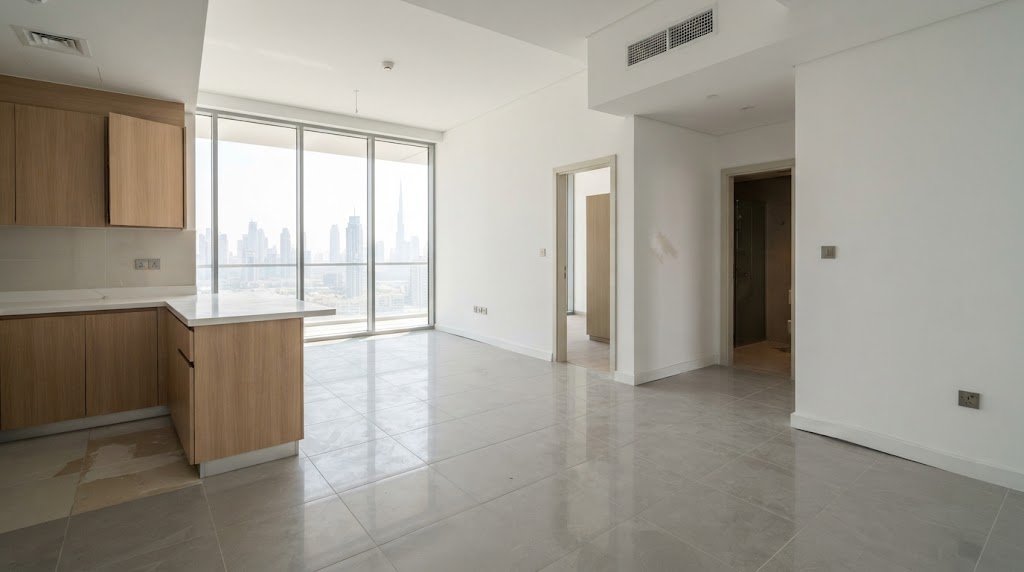
Money Due At Handover
Handover is also when the largest single set of payments falls due, and buyers who budgeted only for the price get caught here.
The table below sets out what typically lands at once. The government transfer fees are published by the Dubai Land Department, which sets them at 2 per cent from the seller and 2 per cent from the buyer, plus an AED 10 knowledge fee and an AED 10 innovation fee.
|
Payment |
Basis |
|
Final instalment |
As set out in your sale and purchase agreement |
|
Transfer fee |
2 per cent seller share plus 2 per cent buyer share |
|
Knowledge fee |
AED 10 |
|
Innovation fee |
AED 10 |
|
Service charges |
Begin once the unit is yours, whether occupied or not |
The government fees are small in wording and large in practice, because the percentage scales with your purchase price. Service charges are the bigger long-term item, and they start whether or not anyone is living in the unit.
Our breakdown of holding costs in Dubai investment properties covers what that looks like annually.
If The Developer Will Not Fix It
Most snags get fixed without drama. When they do not, your position depends almost entirely on what you documented at handover.
The practical sequence looks like this.
-
Put the defect in writing to the developer, with photographs and dates.
-
Reference the handover date, since the one-year installation period runs from it.
-
Keep every reply, and follow up in writing rather than by phone.
-
Escalate to the developer's formal complaints process rather than the sales contact.
-
Take advice on the regulatory route if it is not resolved.
Notice that every step in that list depends on paperwork you either created at handover or did not. This is why the inspection matters more than the repairs. A buyer with a dated, itemised, acknowledged snag list is in a strong position a year later. A buyer who signed and took the keys is arguing from memory.
It is also worth knowing that the protections in Dubai run deeper than the warranty. Off-plan payments are ring-fenced in project escrow accounts under Law No. (8) of 2007, which is published on the same government legislation portal and governs how developer projects are funded and supervised.
Understanding both laws before you buy is part of the wider process we set out in our guide to buying property in Dubai.
Ask This Before You Buy
Handover terms are decided long before handover day, in the contract you sign at the start.
At the Dubai Property Expo in Australia, ask each developer four questions: how much notice you get before the handover window, whether you can send an authorised representative, how the snag list is submitted and acknowledged, and what happens if you refuse handover.
The ones with a clear answer to all four are the ones who have done this properly before.

Frequently Asked Questions
What is snagging in Dubai?
It is the inspection of a newly completed property to identify defects before the buyer accepts handover. The result is a written, dated list given to the developer for rectification.
How long does the developer have to fix defects?
Under Law No. (6) of 2019, the developer remains liable for one year from the date the unit is handed over to repair or replace defective installations, and for ten years from the date of the project completion certificate to remedy defects in the structural parts of the jointly owned property.
Does the ten-year warranty cover my kitchen?
No. The ten-year period covers structural parts, which the law defines as items such as main supports, foundations, columns, structural walls, ceilings, ceiling joists, staircases, stairwells, façades and roofs. Fittings and installations fall under the shorter period.
When exactly does the one-year period start?
From the date the unit is handed over to the owner. That makes the handover date one of the most important dates in your file, so record it and keep the documentation.
Can I refuse handover if the unit is not finished?
Your rights depend on your sale and purchase agreement, so read it before the handover window opens. This is one of the main reasons to have someone authorised and informed present on the day.
Do I need a professional snagging company?
It is not a legal requirement, but a professional report is more thorough and more credible than an amateur walk-through. For an overseas buyer who cannot attend, it is usually the most practical option.
Does snagging apply to a resale property?
You should still inspect thoroughly, but the statutory developer warranty provisions above relate to newly completed property. On a resale, the condition of the unit is a matter for the sale contract.