Quick Answer
-
A holiday home permit is what makes short-term letting of a Dubai property legal.
-
It is issued per unit by the Department of Economy and Tourism, not per owner.
-
Fees start at AED 370 and are capped at AED 1,200 a year per home.
-
Your title deed has to say "Residential" for an apartment to qualify.
-
The unit has to be vacant when the inspector comes.
Plenty of Australians buy in Dubai, picturing short stays rather than a twelve-month tenancy. Higher nightly rates, the option to use the place yourself, no tenant locked in for a year.
That plan is completely legal. It is also licensed, inspected and regulated, and a lot of owners find that out after they have already listed.
The short version is this. Before you accept a single booking, you need a holiday home permit from the Department of Economy and Tourism. It covers one specific unit, it has conditions attached, and the property itself has to qualify before you do.
Here is what the permit involves, what it costs, which properties are eligible, and what the inspection actually checks.
Holiday Home Permit Basics
The permit designates a furnished residential unit as a short-term rental property in Dubai. It is only issued once DET has confirmed the legal and safety requirements are met.
Holiday Home Permit
-
It is granted per unit, so two apartments mean two applications.
-
Both companies and individual property owners can register.
-
An individual owner supplies a copy of their Emirates ID. A company supplies its holiday home licence.
-
Everyone must register on the Holiday Homes System before starting any holiday home rental activity.
-
The permit runs for a minimum of three months and a maximum of twelve.
-
The fees are the same whichever duration you choose, so a three-month permit costs what a twelve-month one does.
That last point is the one worth acting on. If you only plan to let the place out over the winter season, you are still paying the full amount, so you may as well take the longer permit.
Who Cannot
Some properties are simply excluded, and no amount of paperwork changes it.
-
Units classified as hotel rooms or hotel apartments do not get a permit.
-
Properties whose sale and purchase agreement prohibits short-term rentals do not get one either.
That second exclusion is the one to check before you buy, not after. Read the SPA. If short-term letting is the reason you are buying, and the contract bans it, the whole plan is dead on arrival. It is worth reviewing alongside the current off-plan Dubai property listings if you are considering a new build.
What Property Qualifies
Eligibility turns on what the title deed says, not on what the building looks like.
|
Property type |
Title deed classification required |
|
Apartments |
Residential |
|
Villas or houses in gated communities |
Residential or Commercial |
|
Independent villas in Hatta |
Commercial or Farms |
Insurance is a separate condition, and it is not optional:
-
You need a comprehensive policy from a Dubai-licensed insurance company.
-
It must cover potential damages or injuries to guests.
-
It must stay valid for the entire duration of the permit.
An Australian landlord policy does nothing here. The insurer has to be licensed in Dubai.
Documents You Will Need
Applications stall on paperwork more than anything else. Gather this before you start.
-
Title deed, or a Dubai Land Department-approved sale and purchase agreement.
-
NOC from the developer, where applicable.
-
Landlord's signed passport copy or Emirates ID.
-
Trade licence, if the landlord is a company.
-
Emirates ID or passport copy of the authorised signatory.
-
Property Management Letter, using the template available on the portal.
-
Latest DEWA bill.
The developer NOC is the item most likely to hold you up, because it depends on the building's own rules rather than on DET. Some communities have their own conditions for holiday home operators on top of the permit. Ask the building management early, not after you have paid.
How The Application Works
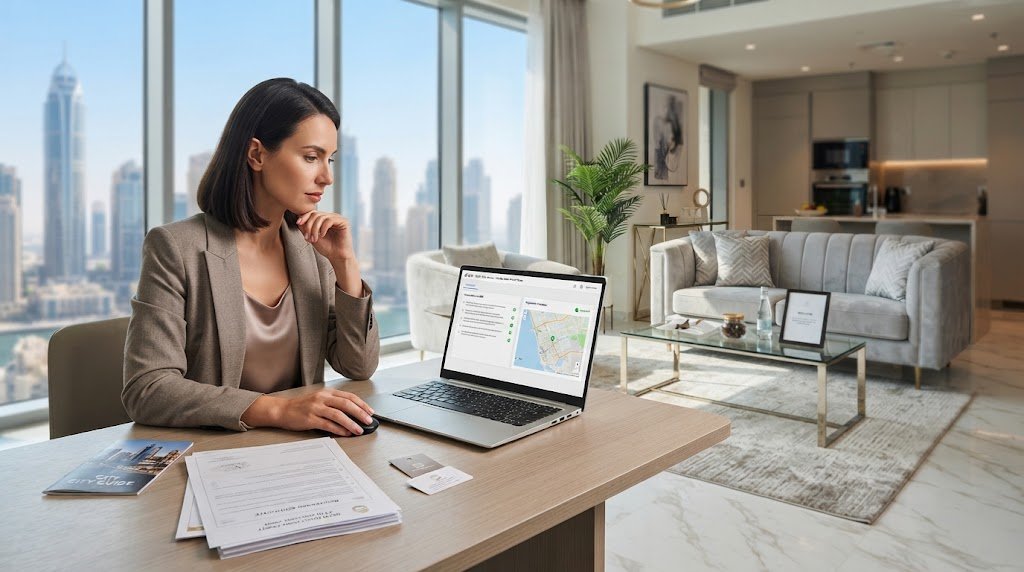
The whole process runs through the Holiday Homes System portal. There is no counter to visit.
-
Log in to the portal and sign in, creating an account first if you do not have one.
-
Click Add Unit and provide your property details.
-
Enter the unit type, number of bedrooms, total area, and developer.
-
Upload all the supporting documents.
-
Review everything and confirm. Applications are usually reviewed within one business day.
-
Once approved, the unit appears on your dashboard for self-classification.
-
Submit the classification and pay the fees to move the unit status to Approved.
Self-classification is not a formality. You are declaring a standard, and the unit is expected to match it from that point on.
Holiday Home Permit Fees
The fee structure is per bedroom, which is why a studio and a four-bedroom villa pay very different amounts.
|
Item |
Amount |
|
Service fee |
AED 300 per bedroom |
|
Classification certificate |
AED 50 |
|
Knowledge fee |
AED 10 |
|
Innovation fee |
AED 10 |
|
Minimum total |
AED 370 |
|
Annual maximum per holiday home |
AED 1,200 |
Source: Department of Economy and Tourism fee schedule, as reported by Gulf News. All fees are paid online through the Holiday Homes Portal. Confirm current amounts on the portal before you budget, since government fees are updated from time to time.
Against Dubai nightly rates, AED 370 is not the number that decides anything. The permit is cheap. The operating obligations behind it are what cost you time.
The Inspection
DET inspects the property to confirm it meets safety and quality requirements. Australians running the unit remotely need to plan around this.
-
The unit must be vacant during the inspection.
-
If violations are found, you receive a warning or a penalty.
-
Violations must be corrected within two weeks.
-
DET may carry out periodic unannounced inspections after the permit is issued.
Two weeks is not long when you are in Melbourne, and the problem is in Dubai Marina. Whoever manages the property locally needs the authority and the budget to fix things without waiting for you to wake up. If you do not have someone on the ground, that is the gap to close before you apply, not after.
Ongoing Obligations
The permit is the start of the relationship with DET, not the end of it.
-
Tourism Dirham is collected on guest stays and remitted to DET, with the rate depending on whether the unit is classified Standard or Deluxe. Check the current rate on the portal.
-
The classification standard you declared has to be maintained.
-
Insurance has to stay valid for the whole permit period, not just at application.
-
Permits are tied to the unit, so selling or changing the arrangement means revisiting the paperwork.
-
VAT may apply once turnover passes the Federal Tax Authority thresholds. Speak to an accountant if you are running more than one unit.
-
If you are an Australian tax resident, the income still has to be declared in Australia, and the ATO has specific rules on what you can claim against foreign rental income.
Short-term letting also carries costs that a twelve-month tenancy does not: cleaning between stays, linen, consumables, utilities in your name rather than the tenant's, and vacant nights. Run those numbers honestly against the ongoing costs covered in our guide to Dubai investment properties before deciding this beats a standard lease.
Is It Worth It
For the right unit in the right location, the maths works. Short stays in tourist areas can clear more than an annual tenancy on the same apartment. For a unit in a quiet residential community with no tourist demand, it usually does not, and you have taken on a licence, an inspection regime and a cleaning roster for nothing.
The honest test is whether your building and location actually attract short-stay guests, and whether you have someone in Dubai who can run it properly. If the answer to either is no, a standard tenancy is the better business. Our guide to buying property in Dubai covers the purchase side either way.
Ask Before You Buy, Not After
The worst time to discover a building bans short-term letting is after you own a unit in it.
At the Dubai Property Expo in Australia, ask every developer three questions: does the sale and purchase agreement allow short-term rentals, does the owners association permit holiday home operators, and will they issue the NOC? Get the answers before you sign, not after handover. Register for the expo and bring the questions with you.
Frequently Asked Questions
Do I need a holiday home permit to list my Dubai apartment on a booking site?
Yes. Short-term letting of a residential unit in Dubai requires a permit from the Department of Economy and Tourism, issued per unit after the legal and safety requirements are confirmed.
How much does a holiday home permit cost in Dubai?
The service fee is AED 300 per bedroom, plus AED 50 for the classification certificate and AED 10 each for the knowledge and innovation fees. The minimum total is AED 370, and the annual maximum is AED 1,200 per holiday home.
How long does a holiday home permit last?
A minimum of three months and a maximum of twelve. The fees are the same regardless of the duration you select.
Can I get a permit for any Dubai property?
No. An apartment needs "Residential" on the title deed. Villas in gated communities can be Residential or Commercial. Hotel rooms and hotel apartments are excluded, and so is any property whose sale and purchase agreement prohibits short-term rentals.
Do I need to be in Dubai for the inspection?
You do not have to attend personally, but the unit must be vacant when DET inspects, and any violations must be corrected within two weeks. That is difficult to manage without someone local.
Can I register as an individual, or do I need a company?
Both are allowed. An individual owner registers with a copy of their Emirates ID. A company or establishment registers with a copy of its valid holiday home licence.
How long does approval take?
Applications are usually reviewed within one business day once submitted. Gathering the documents, particularly the developer NOC, takes far longer than the review itself.